Tuesday, June 17, 2014

Turkey Day 4: Cappadocia

On the fourth day, we got up early to catch a flight to Kayseri, a city in central Turkey. When we got there, we took an hour-long bus ride to Cappadocia, which is an area full of wonders. We went first to an underground city. The people there built these underground cities hundreds (maybe thousands) of years ago as a place of refuge against attacks from their enemies. Each family had a room to themselves (pictured on the right), and then other areas, such as the kitchens, were common. Over 200 underground cities have been excavated in the area, ranging from 2 to 8 stories deep.

We weren't sure if Luke was going to make it through all the tunnels, but he did!


From the outside

After the underground tour, we visited a shop on the side of the street that sold a bunch of different foods, teas, candies, etc. Below are sesame-covered peanuts, which were delicious.

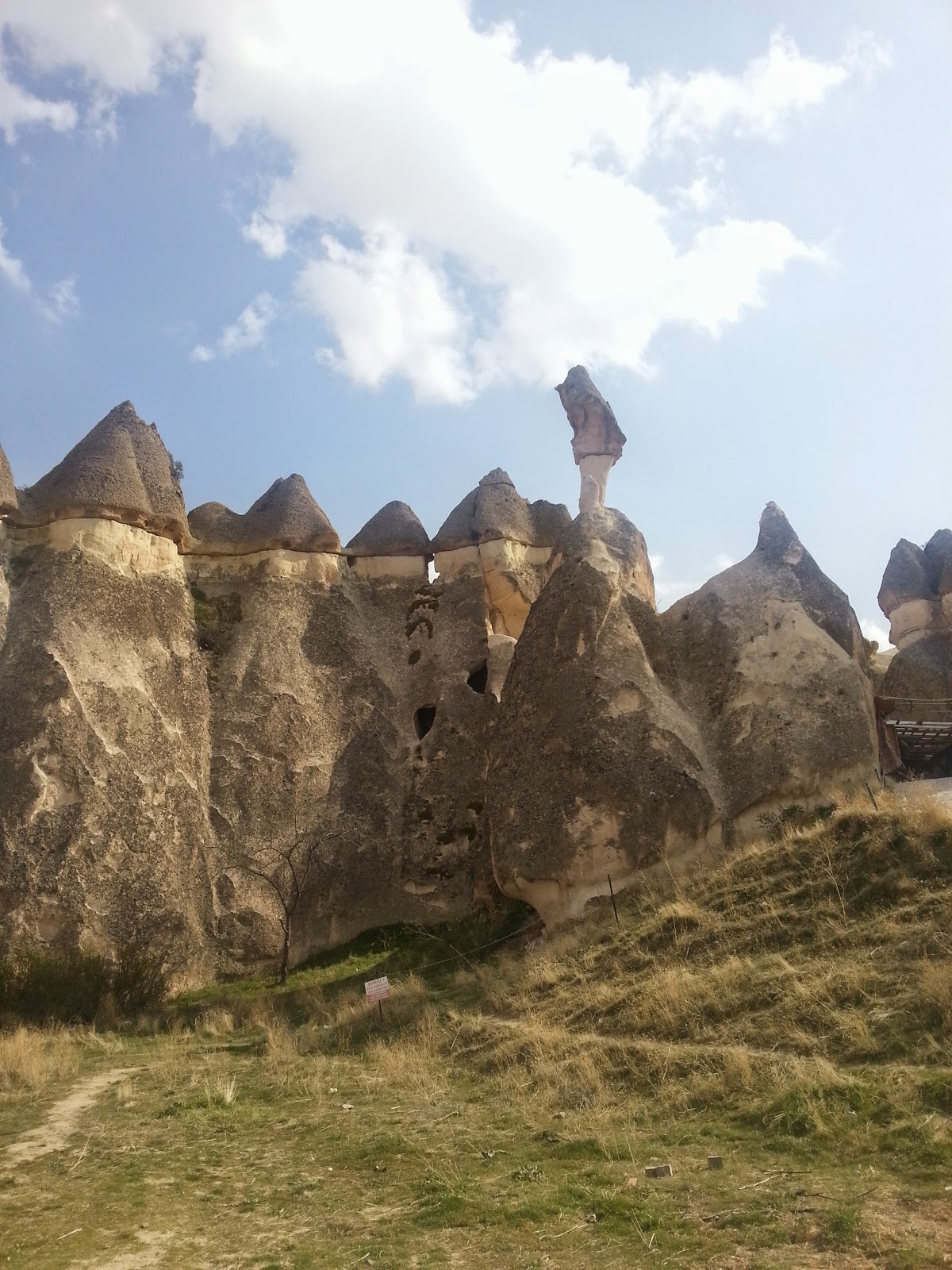
Our next stop was an area full of a geographic formation referred to as fairy chimneys. Through some interesting erosion processes, the rock has been reduced to these pointy towers. Hot air ballooning is popular here early in the morning, but we didn't make it at the right time. We had a tour guide here, who I thought was the least annoying of them all, although she did "you know" a lot. She kept us moving at a quick pace, though, which I appreciated.


Many of these chimneys have been carved out and turned into houses, churches, stores, etc. Many of them are no longer inhabited, but in the town there are still some being lived in. In one park that we visited, you could climb inside and see what they were like.


We visited Goreme Museum, which has several rock churches (no longer in use) which have paintings and carvings inside. We weren't allowed to take pictures inside, but they were pretty impressive. The one below used to be used as a convent.


That day we also visited a ceramics shop, where we learned about their traditional way of making pottery with a kick wheel. Luke got to try it out.

Each one was hand stenciled and painted.

This color combination and pattern on pottery was all over Turkey in the markets and shops we visited. I LOVED it and I wanted to buy it all. It's all quite expensive, though, so I settled with a trivet, which is now packed away safely until I someday get my own kitchen again.

Monday, June 16, 2014

Turkey Day 3: Istanbul

We went back to tour Hagia Sophia, since it was closed the day before. We took a few more pictures in front of the Blue Mosque, since they're just across the plaza from each other. The Bernadacs:

Hagia Sophia

Apparently Hagia Sophia is very famous in the art world, so Luke was nerding out hardcore, since he's an art teacher. He pointed out a lot of things that I now don't remember (the effects of waiting 2 months to blog), but I do remember something about the mosaic of Christ above this door being the first of its kind.

It's hard to show how absolutely cavernous this place was inside. The ceilings were incredibly high and everything inside was just huge. I guess you can see by these chandeliers, which were probably about 9 feet off the ground and then you can see how much distance there was between them and the ceiling. And then the doors, which were about 3 times as tall as an average person.

Hagia Sophia was built in 537 A.D. as a cathedral during the Byzantine and Latin Empire, then was converted to a mosque during the reign of the Ottoman Empire and now is a museum open to all. It is featured on many Seven Wonders of the World lists and it's not hard to see why.


Also for scale, that circular sign with Arabic writing on it is probably ten-feet tall.


When Luke first told me these pictures on the wall were mosaics, I had a hard time believing him. It looked like painted plaster to me. But sure enough, the closer you get the easier it is to see that they're made up of thousands of tiny tiles. Most of them have not yet been fully restored.


View of the Blue Mosque through the window in Hagia Sophia.

After we were finished at Hagia Sophia, we found a cafe on the plaza and had some tea (or water) and baklava. I've never really been a huge fan of baklava - it always seemed soggy to me, but my time in Turkey has converted me. This baklava was probably some of the best we had the whole trip, and trust me, we had a lot.


We went back to the bazaar that afternoon, but also went to some outdoor markets. This part also reminded me of Argentina - masses of people shopping for everything at very specialized shops. No Wal-Mart or Target here.

Like I said, there are mosques everywhere in Istanbul. It's like LDS churches in Utah, except these have very tall minarets so they're easy to pick out among all the buildings. I think there are three different mosques in this picture.

That afternoon we went on a boat ride along the Bosphorus, which is a strait that connects the Sea of Marmara and the Black Sea and forms part of the border between Europe and Asia. It's a high traffic area, with tons of boats and ships of all sizes, from fishing boats to ocean liners. There was plenty to see in the water and all of Istanbul to see on land.

Amy, Kelly, Daniel Allen, and Arslan

Luke

Dolmabahce Palace, which was the main administrative center of the Ottoman Empire from 1856 to 1922.

Here I am with those bridges again. This is either the Bosphorus Bridge or the Fatih Sultan Mehmet Bridge.

Mandy in front of Beylerbeyi Palace, built in the 1860s as a summer residence for the Sultan. We visited this place a few days later.

Rumelian Castle, built in 1452.


Fishermen off the bridge